
 Hedging
 Liquidity Solutions
 Cash Flow Forecasting
 Corporate Treasury Outsourcing
 Treasury Tecnology
 Connectivity
 Supply Chain Finance
 SME Forex
 Money Market Funds
 The SARB resumed its monetary policy easing cycle in May, cutting the Repo Rate by 25bps to 7.25%. The vote among MPC members was split 5-1, with the dissenting voice favouring a 50bp rate cut.
The case for further interest rate cuts remains, with the ZAR appreciating notably in recent weeks and inflation remaining below the lower end of the 3%-6% target band.
Global financial market conditions have also settled following the volatility seen during the peak of the Israel-Iran conflict. The VIX Index is tradi ng well below the 20-mark once again to signal that risk-on conditions remain entrenched, while global oil prices have also receded with Brent below $70 per barrel once again.
Of course, one needs to factor in the high possibility that the SARB’s inflation mandate will be adjusted in the coming months. As it stands, the revised target will likely be set at a fixed 3%. Achieving this target will require higher interest rates in the near term to keep inflation pressures contained.
 However, until the change is formalised, the SARB will act under its current mandate, which keeps the door open to further rate reductions.
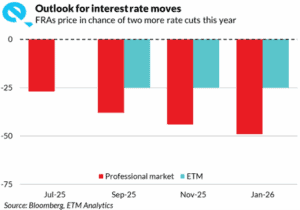
In the markets, FRA’s are currently pricing in a rate cut at this month’s MPC meeting, with a second rate cut largely expected by the January 2026 meeting.
This aligns with the path set forward by the SARB’s own QPM model. ETM’s expectations, however, are more conservative as we expect a 25bp rate cut in September.
By then, many uncertainties regarding the global backdrop will be clearer. If the inflation target is adjusted before the end of the year, there will need to be a reset of expectations, with interest rates then likely to be kept on hold until inflation expectations settle closer toward the new 3% target level.
Read report