
 Hedging
 Liquidity Solutions
 Cash Flow Forecasting
 Corporate Treasury Outsourcing
 Treasury Tecnology
 Connectivity
 Supply Chain Finance
 SME Forex
 Money Market Funds
|
Key Points:
BASELINE VIEW: The SARB has resisted the urge to ease monetary policy further in its efforts to anchor inflation and inflation expectations closer to 3%. While some might bemoan keeping interest rates at such elevated levels, the benefits will be material over the medium- to longer-term. Higher real interest rates, lower overall inflation, and attractive returns compared to global peers will bolster the ZAR’s resilience at a time when global economic uncertainty remains elevated. SARB leaves rates unchanged amid uncertainty over inflation outlook |
 |
|
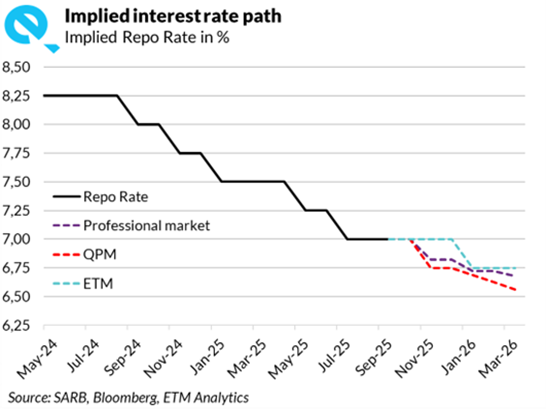
The SARB left interest rates unchanged at the September MPC meeting. The vote was split: four members opted for no change, while two preferred a 25bp rate cut. The outcome matched our estimates and the broader consensus within the market. However, there were some interesting developments, including a shift higher for inflation estimates across the forecast horizon. Specifically, headline inflation is expected to rise over the next few months, peaking at around 4% in Q4 2025, with the bank’s forecast incorporating a higher electricity price inflation rate of nearly 8% rather than 6%, given the recent pricing correction by NERSA. The Bank highlighted how structural inefficiencies in administered pricing continue to erode purchasing power and weigh on growth. Sector-specific reforms are needed to boost efficiency, rather than tolerating higher inflation as the SARB pushes for the official adoption of a lower inflation target. Any structural reforms that take place would benefit the economic growth outlook and the ZAR. Economic growth forecasts were also revised higher, while the QPM output shifted to suggest one fewer 25bp rate cut through 2027. The QPM suggests that a rate cut at the November MPC meeting is still possible. The market has adjusted its expectations for further rate cuts, now expecting just one more by the March 2026 meeting. ETM’s expectations align with this as we see the next cut in early 2026, although we do not rule out a November cut if inflation surprises to the downside. |