
 Hedging
 Liquidity Solutions
 Cash Flow Forecasting
 Corporate Treasury Outsourcing
 Treasury Technology
 Connectivity
 Supply Chain Finance
 SME Forex
 Money Market Funds
|
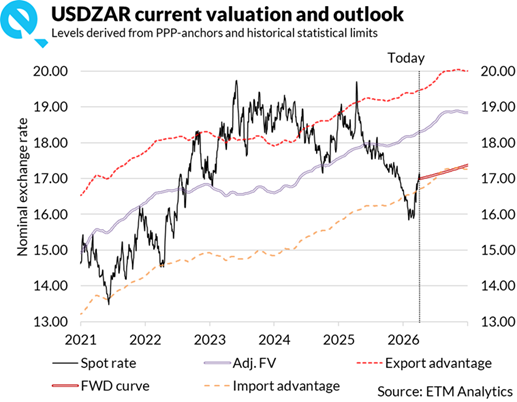
Currency: The rand had a strong run for most of the past year, climbing steadily against the dollar, but it hit a rough patch in March as war in the Middle East rattled global markets and investors pulled back from riskier assets. It was the worst-performing emerging market currency that month, losing nearly 7% against the dollar alone.
The trigger was the conflict around Iran and the closure of the Strait of Hormuz, which sent shockwaves through currency markets worldwide. That said, even after this recent pullback, the rand is still considered undervalued against the dollar, meaning it is trading cheaper than what economic fundamentals suggest it should be worth.
South Africa’s economic and fiscal picture continues to improve relative to its peers, which underpins the rand’s longer-term outlook. If tensions in the Middle East ease meaningfully, the rand could resume its recovery. For now, the rand is at the mercy of what happens in the Middle East and will trade a tad on the weak side.
|
 |
|
Inflation: Headline consumer inflation slowed by more than expected from 3.5% y/y in January to 3.0% y/y in February, the lowest since June 2025 and in line with the SARB’s new inflation target. Core inflation (excluding food and energy) decelerated to 3.0% y/y from 3.4% y/y in January. Disappointingly, elevated oil prices linked to the Middle East war are expected to feed into a surge in inflation from April, compounded with ZAR depreciation. CPI is expected to move above 4.0% in the coming months.
Repo rate: The SARB held rates steady, choosing to wait for clearer signs on whether the Iran war will be short-lived or prolonged. The inflationary and market impacts will largely depend on the duration, with a quick resolution likely leading to only temporary price pressures and limited financial disruption.
Government Finances: The year-to-date budget deficit stood at -R285.3bn compared to -R323.6bn in the 2024/25 fiscal year, pointing to an improved fiscal position. Recent external developments have partly unwound these gains, with bond yields moving higher and precious metal prices easing. Furthermore, the April reduction in the fuel levy will negatively impact government revenue. The overall impact of the conflict on the domestic fiscal outlook will ultimately hinge on how prolonged the war becomes.
GDP Growth: Q4 GDP growth rose marginally to 0.4% from 0.3% in Q3. On an annual basis, the economy grew by 1.1% in 2025, up from 0.5% in 2024. Some structural gains in the economy, particularly in energy and transport and logistics, likely supported this modest improvement. However, meaningful progress toward large-scale job creation will require addressing a range of other binding constraints on economic activity with urgency.
Offshore conditions: The escalation of the Middle East conflict drove oil prices higher, lifting inflation expectations and pushing global yields higher. Central banks grew more cautious, with expectations of delayed easing supporting higher yields in developed markets. The US dollar strengthened broadly on safe-haven demand and higher rate expectations. Other commodities also experienced significant pressure, particularly fertilisers and industrial metals, amplifying concerns about inflation risks. Overall, markets traded in a risk-off environment marked by higher volatility and stronger USD demand. |