
 Hedging
 Liquidity Solutions
 Cash Flow Forecasting
 Corporate Treasury Outsourcing
 Treasury Technology
 Connectivity
 Supply Chain Finance
 SME Forex
 Money Market Funds
Key points
- On December 19th, the BoJ indicated that it had hiked rates by a further 25 basis points, to take the central bank rate up to 75 basis points, or the highest level in over thirty years. This is indeed a significant development, and one that should be closely monitored as it has far-reaching implications for currencies exposed to the carry trade.
- The ZAR is one such currency and it is worth trying to understand the implicatons for the ZAR better and whether this is something that might derail the performance of the ZAR, or whether it is just one more factor that will count against the performance of the USD, in which case the ZAR is in a strong position to be able to capitalise on its new found virtuous cycle that appears to have given the ZAR abn unfamiliar resilience.
BASELINE VIEW:
Despite the BoJ’s decision to protect the JPY over the longer term by dissuading carry trades funded in JPY, the ZAR appears to be in a strong position, implying that the ZAR will enjoy some ongoing resilience, regardless of what the USD-ZAR valuation charts show. This remains a constructive environment for importers.
BoJ hikes as it finally seeks to normalise monetary policy
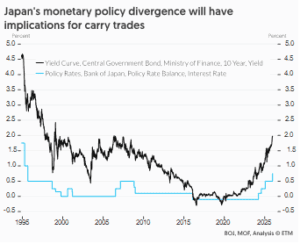 Last week, the BoJ decided to hike rates a further 25 basis points to 75 basis points, the highest level since September 1995. For over thirty years, the BoJ has persisted with ultra-loose monetary policy and briefly experimented with a period of negative interest rates during the pandemic.In a world where most central banks are reducing interest rates, the Bank of Japan’s decision to do the exact opposite will raise some eyebrows and interest. It is a significant development that holds consequences not just for Japan, but for most other countries as well.
The reason this matters so much to a country like South Africa is that it holds significant implications for the carry trade. Over the past three decades, the JPY has become one of the world’s most reliable funding currencies for several reasons. Carry costs were negligible, and the JPY always held an underlying bias towards depreciation, prompting the BoJ to threaten interventions on numerous occasions.
Read more