
 Hedging
 Liquidity Solutions
 Cash Flow Forecasting
 Corporate Treasury Outsourcing
 Treasury Tecnology
 Connectivity
 Supply Chain Finance
 SME Forex
 Money Market Funds
|
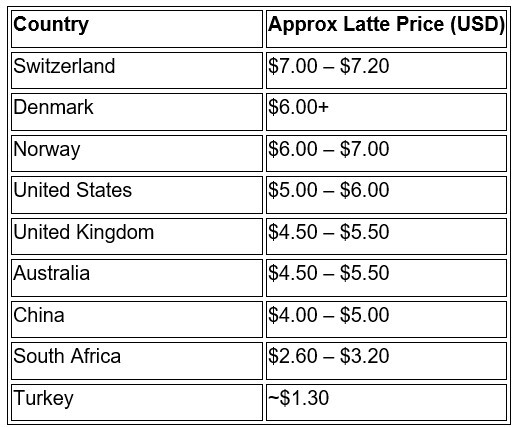
For decades, economists have relied on the Big Mac Index as a simple way to judge whether currencies are fundamentally overvalued or undervalued. But in a modern urban economy, coffee may actually tell a richer story than burgers. This is where the Latte Index becomes fascinating. At an exchange rate of roughly R16.60 to the US dollar, South Africa remains one of the cheapest places in the world to buy premium coffee – at least in dollar terms. Yet for local consumers, a cappuccino still feels expensive. That contradiction reveals far more about the global economy than the rand alone. Recent international coffee pricing studies show enormous variation in the price of a standard Starbucks tall latte around the world. Switzerland remains the most expensive major coffee market, with a latte costing over $7, while countries such as Turkey and Brazil sit near the bottom of the scale. South Africa consistently ranks among the cheaper global markets, with premium coffee generally costing the equivalent of $2.60–$3.20. At current exchange rates, a R50 latte in Johannesburg converts to just over $3. Compare that globally: |
 |
|
On the surface, this suggests that the rand is significantly undervalued from a purchasing-power perspective. A foreign tourist landing in Cape Town effectively receives far more coffee, and by extension, more local services and lifestyle consumption, for each dollar spent than they would in Europe or North America. But the real story lies in why the prices differ so dramatically. The first and biggest driver is labour cost. Coffee shops are labour-intensive businesses. Every cappuccino requires baristas, cleaners, managers, logistics staff, and retail employees. In countries such as Switzerland, Norway, and Denmark, wages are extraordinarily high. A Swiss barista may earn several times what a South African counterpart earns, once converted to dollars. Those wage costs flow directly into the price of every cup sold. This is one of the classic explanations behind Purchasing Power Parity and the Balassa-Samuelson effect: richer countries tend to have higher service-sector prices because wages across the economy are structurally higher. The second major factor is commercial rent and real estate costs. A Starbucks in Zurich, London, or Manhattan operates in some of the most expensive retail property markets on earth. Prime urban retail space in developed markets can cost multiples of what equivalent locations in Johannesburg or Durban cost. Those costs are embedded in every latte. Third comes taxation and regulation. European countries generally impose higher VAT rates, stricter labour protections, healthcare obligations, pension contributions, and environmental compliance costs. All of those increase operating expenses. South Africa certainly has regulatory burdens of its own, but not on the same scale as Northern Europe. Then there is the issue of tradable versus non-tradable costs. Coffee beans themselves are globally traded commodities. A coffee bean imported into South Africa may cost roughly the same as one imported into Germany or the UK, once shipping and quality are taken into account. Espresso machines, refrigeration equipment, cups, and imported syrups are also globally priced. This creates an interesting split in the final price of a latte:
That is why South African coffee is not ultra-cheap despite lower wages. Imported components still anchor part of the price to global markets. In fact, premium coffee pricing in South Africa increasingly resembles developed-market pricing in rand terms because many underlying inputs are dollar-linked. Electricity costs, logistics, fuel, imported milk substitutes, machinery, and rental escalation clauses all push local coffee prices upward even when wages remain relatively low. This is why many South Africans still perceive coffee chains such as Starbucks, Vida e Caffè, and Seattle Coffee Company as premium experiences rather than everyday purchases. The Latte Index also exposes one of the biggest flaws in simplistic PPP comparisons. A country can appear “cheap” internationally while simultaneously feeling expensive domestically. For a New Yorker earning dollars, South Africa feels extraordinarily affordable. For a South African consumer earning in rand amid elevated unemployment, weak wage growth, and persistent inflation, a R55 cappuccino may still represent a meaningful discretionary spend. In other words, the rand may be undervalued, but that does not automatically mean South Africans are wealthy in real consumption terms. The latte, therefore, becomes a miniature snapshot of global inequality, wage divergence, currency valuation, and cost-of-living dynamics. |