
 Hedging
 Liquidity Solutions
 Cash Flow Forecasting
 Corporate Treasury Outsourcing
 Treasury Technology
 Connectivity
 Supply Chain Finance
 SME Forex
 Money Market Funds
|
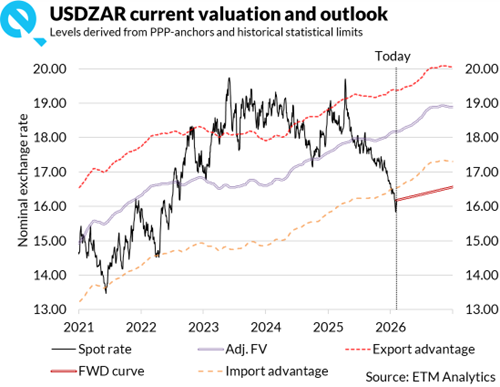
Currency: The Rand began the year on a strong footing, supported by broad emerging market currency strength and record highs in gold and platinum prices, which improved South Africa’s terms of trade and drove a 2.6% appreciation against the USD in January (with more modest gains of 1.6% vs EUR and 0.9% vs GBP).
However, early February saw some correction as global market volatility increased and gold prices retreated from their recent peaks, prompting USD/ZAR to rebound from its late-January lows near R15.65. While the rand now screens somewhat overvalued against the dollar on a risk-adjusted basis, the broader structural drivers of USD softness and Rand resilience remain in place — including US policy uncertainty, global reserve diversification into gold, and South Africa’s reform trajectory.
The upcoming 2026 Budget Speech will be a key near-term catalyst, with fiscal discipline and debt stabilisation central to sustaining positive sentiment.
Overall, provided global risk conditions stabilise, the medium-term outlook for USD/ZAR remains biased to the downside (rand supportive), though near-term volatility and corrective rebounds should be expected.
|
 |
|
Inflation: Headline consumer inflation increased marginally and in line with consensus estimates to +3.6% y/y in December from +3.5% y/y in November. The economy continues to benefit from a muted inflation environment, underpinned by the rand’s strong performance and persistently low oil prices. In the coming months, headline CPI could decline.
Repo rate: The SARB opted to keep the repo rate unchanged at 6.75% last month despite a stronger ZAR and subdued inflation. This decision builds credibility around the SARB’s new 3% inflation target.
Government Finances: The year-to-date (Apr-Dec25) borrowing requirement widened to -R374.7bn, compared with -R226.7bn over the same period in 2024/25. The still-elevated gross borrowing requirement underscores the continued weakness in the government’s fiscal position, despite ongoing year-to-date primary budget improvements during 2025/26.
GDP Growth: Q/Q seasonally adjusted growth declined slightly from 0.9% in Q2 to 0.5% in Q3. Gross fixed capital formation (GFCF) improved moderately, largely driven by transport. Alongside the improvement in exports, one suspects that the impact of Operation Vulindlela on restructuring the transport sector is beginning to yield fruit. Nonetheless, growth remains fairly pedestrian overall, at around 1%, suggesting that further reforms are necessary to boost the economy.
Offshore conditions: The year opened with volatility as markets reacted to Trump’s fluid tariff rhetoric. Proposed levies on European goods tied to Trump’s Greenland takeover ambitions were later paused, but renewed threats followed after US allies, including Canada and the UK, engaged China on trade. Regarding monetary policy, the Fed ultimately held rates steady, with guidance reinforcing market pricing for a potential July rate cut. Fortunately, concerns over Fed independence faded at the end of the month after Kevin Warsh was named the next Fed Chair, tempering expectations of a sharp dovish pivot. |