
 Hedging
 Liquidity Solutions
 Cash Flow Forecasting
 Corporate Treasury Outsourcing
 Treasury Technology
 Connectivity
 Supply Chain Finance
 SME Forex
 Money Market Funds
|
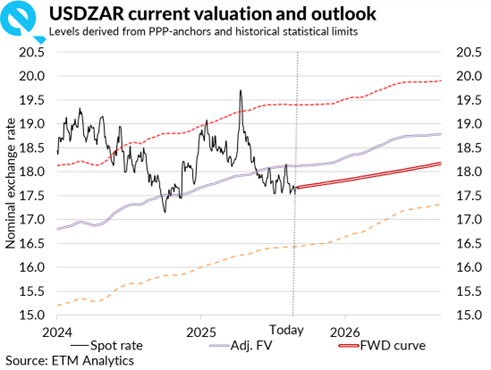
Currency: The rand had a good August, gaining about 3% vs the dollar and ranking as a top EM performer. A big driver was a softer, shakier USD: it’s still roughly 14% overvalued on a trade-weighted basis, US data have cooled, and policy noise (including Fed-independence worries and tariff rulings) boosted bets on a September Fed cut, even talk of 50bp. That backdrop leaves room for more rand strength if the Fed eases more than markets expect.
Still, after the rally the rand starts to become a bit “over-valued” on risk-adjusted models, so near-term moves may be choppy, with a mild bias to a stronger rand towards the R17.00 level, while USD valuations correct.
|
 |
|
Inflation: Headline CPI accelerated from +3.0% y/y in June to +3.5% y/y in July, marking the highest reading since September 2024. This rise will be perceived as significant, following the SARB’s recent announcement that its preferred inflation target will be 3%, i.e. the lower end of its mandated 3% to 6% inflation target. Inflation is expected to continue rising, albeit moderately. Repo rate: The SARB’s response to rising inflation in the context of its push for a 3% inflation target will be a key theme in the coming months. Considering July’s higher CPI reading, SARB MPC members might prefer to keep interest rates slightly higher to anchor inflation expectations closer to the lower target, especially given recent multi-year, above-4% wage agreements by trade unions. While a September interest rate cut is unlikely, ongoing increases in inflation also reduce the likelihood of a cut at the November MPC meeting. Government Finances: On a year-to-date basis, the government budget shortfall stands at -R162.6bn, compared to -R199.6bn in the 2024/25 fiscal year. Overall, the domestic fiscal outlook remains weak, with public debt forecast to rise during 2025/26. Unless the government makes a concerted effort to reduce spending and raise revenue by liberalising economic growth through policy reform, the fiscal outlook will continue to deteriorate, even as National Treasury forecasts predict a stabilisation in debt. GDP Growth: SA’s GDP grew by just 0.1% q/q in Q1, slowing from 0.4% in Q4. Y/y growth held steady at 0.8%. Without a second consecutive quarter of robust agricultural growth (+15.8%), overall GDP would have contracted. Particularly concerning is the significant decline across the productive sectors as mining output and manufacturing shrank by 4.1% and 2.0%, respectively. Currency: The ZAR ended August 3% stronger against the USD, making it the fourth-best performing emerging market currency against the greenback in the month. The USD remains some 14% overvalued on a real effective basis, suggesting the greenback still has some way to slide. It also appreciated vs the EUR, GBP and JPY, but the moves were not greater than 1%. Offshore conditions: Trump’s protectionist policies and concerns surrounding Fed independence are detracting from the greenback’s safe-haven appeal. Perceived Fed interference is also clouding the outlook for US interest rate cuts. Consequently, investors have found refuge in safe-haven assets like gold as it nears record highs. Globally, investors are concerned about rising fiscal risk in advanced economies, which is driving longer-dated yields sharply higher. |