
 Hedging
 Liquidity Solutions
 Cash Flow Forecasting
 Corporate Treasury Outsourcing
 Treasury Technology
 Connectivity
 Supply Chain Finance
 SME Forex
 Money Market Funds
|
Currency: The rand finished November on a strong footing, supported by a rebound in global stock markets and rising demand for riskier assets.
South Africa continues to attract investors thanks to comparatively high interest rates and solid commodity prices, while recent local developments — including a well-received budget update, improved cooperation in the Government of National Unity, progress on structural reforms, and an S&P rating outlook upgrade — have also helped sentiment.
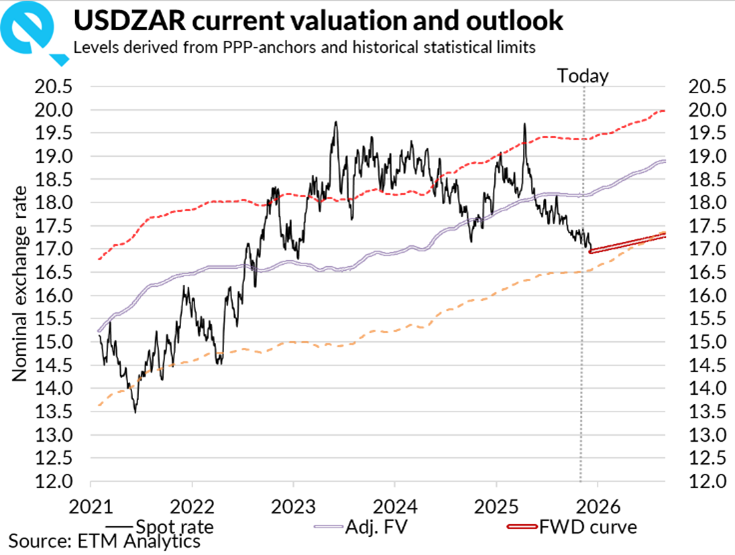
Although the rand looks slightly stronger than long-term fair value would suggest, the US dollar is still overvalued and may weaken further as the US economy slows and more interest rate cuts through.
This combination points to the potential for some additional rand strength in the near term towards the R16.75 level, though gains may start to level off as valuation limits are reached.
|
 |
|
Inflation: Headline CPI increased by slightly less than expected in October, to +3.6% y/y from +3.4% y/y in September. Higher fuel costs thus drove the uptick while food inflation slowed for a third straight month. Overall, SA’s inflationary outlook remains subdued, and inflation could fall back slightly by the end of the year. Repo rate: The SARB cut interest rates by 25bp last month. Although this was the first meeting under the newly formalised inflation-targeting framework, policymakers agreed that monetary conditions could be eased without jeopardising progress toward the new target. The SARB QPM model forecasts interest rates to average 6.19% by end-2026 and 5.99% by end-2027. Government Finances: From a ytd perspective, the main budget deficit (-R266.4bn) continues to report improved readings compared to the same period in the 2024/25 fiscal year -R302.1bn. The government has received a helping hand from the SARB’s inflation target shift, which helps to reduce interest rates and, in turn, leads to lower interest payments. GDP Growth: Q/q seasonally adjusted growth declined slightly from 0.9% in Q2 to 0.5% in Q3. Gross fixed capital formation (GFCF), saw a moderate improvement, driven in large measure by transport. Alongside the improvement in exports, one suspects that the impact of Operation Vulindlela on restructuring the transport sector is beginning to yield fruit. Nonetheless, growth remains fairly pedestrian overall, at around 1%, indicating that more reforms are necessary to lift the economy. Offshore conditions: In November, global markets were shaped by the resolution of the US government shutdown, easing a major source of uncertainty and restoring confidence among investors. US equity markets rebounded, boosting risk appetite and supporting the US dollar, while expectations for further Federal Reserve rate cuts have increased. Meanwhile, commodity markets were firmer, with gold sustaining gains and key exporters benefiting from elevated terms of trade. Overall, market sentiment improved as geopolitical and policy uncertainty risks in major economies showed signs of stabilisation. |