
 Hedging
 Liquidity Solutions
 Cash Flow Forecasting
 Corporate Treasury Outsourcing
 Treasury Technology
 Connectivity
 Supply Chain Finance
 SME Forex
 Money Market Funds
|
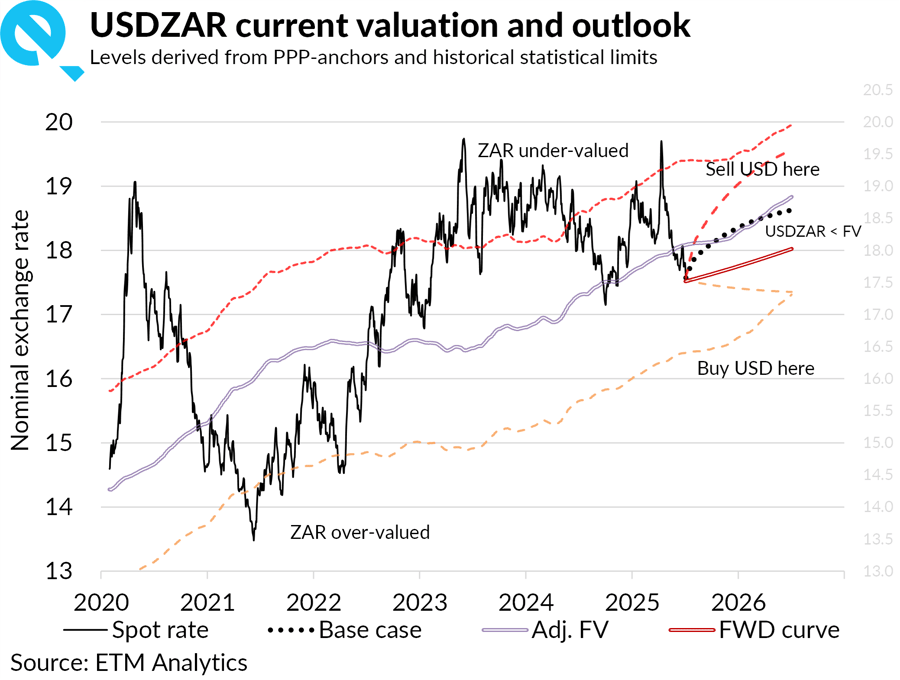
Currency: The rand has strengthened recently, supported by improved global risk appetite, a weaker US dollar, and easing geopolitical tensions, with room for further rand appreciation if domestic reforms continue and global conditions remain stable.
Looking ahead, the USD/ZAR pair could gradually move toward the R17.00 level, assuming no major domestic shocks.
For the remainder of 2025, the rand is expected to trade within a range of R17.00 to R18.40/USD, with strength likely if US rate cuts materialise and local political stability continues under the GNU.
However, if global tensions flare up or fiscal reform stalls, the rand could weaken again toward the upper end of that range. |
 |
|
Inflation: Headline CPI remained unchanged at 2.8% y/y in May. While goods inflation increased in the month, fuel fell further into deflationary territory, with the latter likely to have bottomed out. While domestic inflation is likely to start rising in subsequent months (in part due to a 12.7% average electricity price hike, which takes effect on 1 July), the rebound should be gradual, barring a significant oil price shock amidst ongoing geopolitical tensions.
Repo rate: The SARB resumed its monetary easing cycle in May, cutting the repo rate by 25 basis points to 7.25%. The SARB also revised its inflation forecasts lower, now projecting 3.2% for 2025 and 4.2%-4.4% through 2027, citing a stronger rand, lower oil prices, and the scrapping of VAT hikes. However, growth expectations were downgraded, with 2025 GDP now seen at just 1.2%.
Government Finances: The budget deficit contracted seasonally in May, to -R10.1bn from -R64.6bn in April. While it is early in the current fiscal year, from a year-to-date perspective, the -R74.7bn budget deficit marks a slight improvement from -R90.8bn in the corresponding period during the 2024/25 fiscal year. South Africa’s public debt is expected to rise during the 2025/26 fiscal year, with weak growth expectations weighing on the revenue outlook, and meaningful expenditure cuts unlikely to be made.
GDP Growth: SA’s GDP grew by just 0.1% q/q in Q1, slowing from 0.4% in Q4. Y/y growth held steady at 0.8%. Without a second consecutive quarter of robust agricultural growth (+15.8%), overall GDP would have contracted. Particularly concerning is the significant decline across the productive sectors as mining output and manufacturing shrank by 4.1% and 2.0%, respectively.
Offshore conditions: In the middle of the month, risk appetite soured sharply when the US bombed Iran. Oil prices rose sharply, and investors shifted to safe-haven assets such as the greenback. However, with a fragile ceasefire in place, the market has settled. USD weakness emerged towards the end of the month due to fiscal concerns about the debt impact of President Trump’s $3.4 trillion tax and spending bill, which has passed through Congress. In the coming weeks, the market will need to weigh the stimulatory effects of this bill against its fiscal impact. |