
 Hedging
 Liquidity Solutions
 Cash Flow Forecasting
 Corporate Treasury Outsourcing
 Treasury Technology
 Connectivity
 Supply Chain Finance
 SME Forex
 Money Market Funds
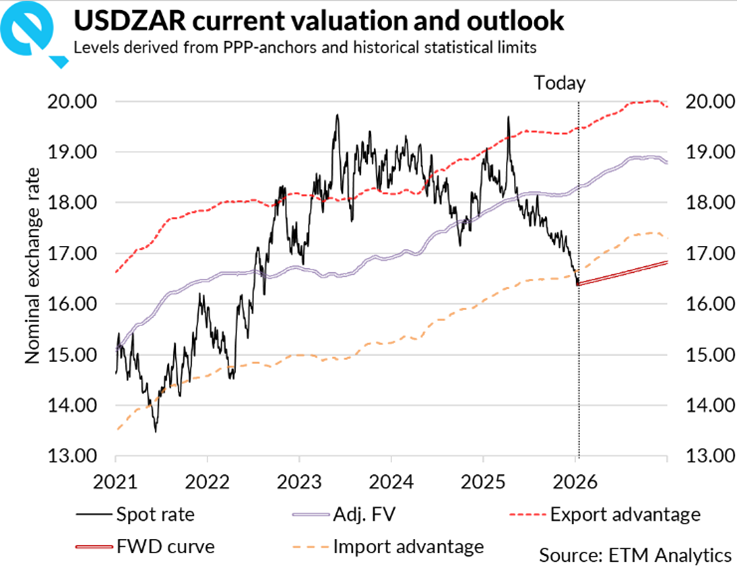
Currency: At the start of 2025, the rand was under significant pressure, with investors wary of political instability and the potential collapse of the Government of National Unity, keeping USD/ZAR at elevated levels, but sentiment shifted decisively as the year unfolded. Confidence returned after the GNU survived the budget standoff and delivered a fiscally responsible budget, reinforced by South Africa’s removal from the FATF greylist, a sovereign credit rating upgrade, and the adoption of a more credible 3% inflation target, while improving global risk appetite and strong commodity prices lifted South Africa’s terms of trade.Together, these factors sparked a sustained and powerful rand rally that accelerated into late 2025 and early 2026. Although short-term volatility and occasional pullbacks have emerged, the underlying fundamentals point to a structurally stronger trading range.Despite valuation models suggesting the currency is overbought, positive sentiment and the prospect of another prudent budget support continued strength, keeping USD/ZAR stronger, with a push towards R16.00 possible.
 |
Inflation: Headline CPI remained stubbornly buoyant at 3.5% y/y in Nov vs the 3.6% y/y in Oct. Overall, SA’s inflationary outlook remains subdued, albeit it above the 3% inflation target and should prompt the SARB to remain somewhat conservative.
Repo rate: The SARB cut interest rates by 25bp in November. Although this was the first meeting under the newly formalised inflation-targeting framework, policymakers agreed that monetary conditions could be eased without jeopardising progress toward the new target. The SARB QPM model forecasts interest rates to average 6.19% by the end of 2026 and 5.99% by the end of 2027.
Government Finances: South Africa’s monthly budget deficit narrowed to -R14.9bn in November from -R35.8bn in October as a result of a R22.9bn increase in revenue, which outweighed a R2.1bn increase in expenditure. While the improved main budget numbers in 2025/26 are welcome, the government must leverage lower borrowing costs and the opportunity for policy reform to run a more balanced budget.
GDP Growth: Q/q seasonally adjusted growth declined slightly from 0.9% in Q2 to 0.5% in Q3. Gross fixed capital formation (GFCF) saw a moderate improvement, driven largely by transport. Alongside the improvement in exports, one suspects that the impact of Operation Vulindlela on restructuring the transport sector is beginning to yield fruit. Nonetheless, growth remains fairly pedestrian overall, at around 1%, suggesting that further reforms are necessary to boost the economy.
Offshore conditions: Global equity markets remain strong and continue to power through the wall of worry about valuations and a global cyclical downturn. With central banks responding by lowering interest rates and companies investing aggressively in AI infrastructure, the US economy appears to be bucking the downturn trend. Whether that remains the case will depend on whether the AI boom continues and how strongly monetary policy supports asset prices. Geopolitically, there are also numerous shifting developments, from Venezuela to Ukraine, Iran, Greenland, China, and Taiwan, but these are not yet boosting risk premia.
Read report