
 Hedging
 Liquidity Solutions
 Cash Flow Forecasting
 Corporate Treasury Outsourcing
 Treasury Technology
 Connectivity
 Supply Chain Finance
 SME Forex
 Money Market Funds
|
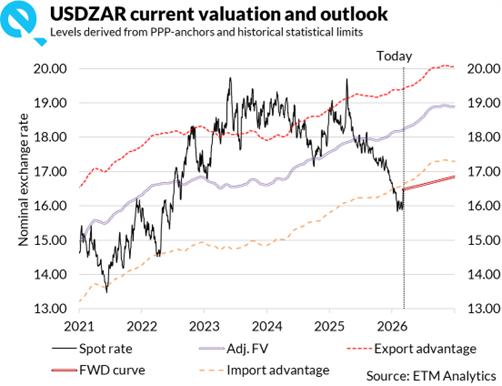
Currency: The Middle East war has driven global risk-off sentiment. The ZAR has depreciated to levels of 16.68/$ at the time of writing, its weakest levels since the end of December 2025. While it has recovered somewhat, on a risk-adjusted basis, the degree of ZAR overvaluation against the USD has lessened (USD-ZAR undervalued).
Much will hinge on the duration and intensity of the Middle East conflict, which has boosted the greenback on safe-haven demand and inflation risk from higher oil prices, pushing US Fed fund futures to move expectations of a July rate cut to September/October.
The effects of ZAR weakness and the rise in oil prices to almost $90/bbl (at time of writing) will be somewhat cushioned by buoyed gold prices on safe-haven demand, which will benefit SA’s terms of trade. Valuations versus the USD were stretched, with heavy foreign buying and hedging activity suggesting the ZAR could face a sharp reversal if sentiment shifted or commodity prices fell. Therefore, the ZAR remains vulnerable to any developments in the Middle East that could further raise risk aversion. |
 |
|
Inflation: Headline inflation eased by slightly less than expected in January to 3.5% y/y from 3.6%. The softer reading marks continued progress toward the SARB’s 3% inflation target, validating the timing of its mandate shift. Looking ahead, inflation is likely to ease further in February. However, further out, much will depend on how long the Middle East war continues and whether ZAR deprecation is sustained or not.
Repo rate: Given the latest developments in the Middle East, which have pushed oil and the ZAR upwards, it is possible that inflation could rise to 4% in March; the SARB will likely keep interest rates unchanged later this month.
Government Finances: While the ytd budget deficit has narrowed to -R312.6bn from -R347.8bn a year earlier, the gross borrowing requirement has worsened to -R444.7bn, largely due to heavy redemptions of maturing government debt. Stronger revenues offer fiscal relief, yet doubts remain over whether the government can sustain consolidation and rein in spending.
GDP Growth: Q/Q seasonally adjusted growth declined slightly from 0.9% in Q2 to 0.5% in Q3. Gross fixed capital formation (GFCF) improved moderately, largely driven by transport. Alongside the improvement in exports, one suspects that the impact of Operation Vulindlela on restructuring the transport sector is beginning to yield fruit. Nonetheless, growth remains fairly pedestrian overall, at around 1%, suggesting that further reforms are necessary to boost the economy.
Offshore conditions: Renewed uncertainty around Trump’s tariff agenda intensified after the Supreme Court overturned his emergency tariffs. Trump then implemented a 15% tariff globally. Meanwhile, late-January FOMC minutes struck a hawkish note and signalled caution on further rate cuts, which underpinned the US dollar. That support has strengthened further as escalating geopolitical risks in the Middle East and the prospect of inflationary pressures from surging oil prices have fuelled a sharp rally in the US dollar. The conflict will keep uncertainty levels high and market volatility elevated. |