
 Hedging
 Liquidity Solutions
 Cash Flow Forecasting
 Corporate Treasury Outsourcing
 Treasury Tecnology
 Connectivity
 Supply Chain Finance
 SME Forex
 Money Market Funds
|
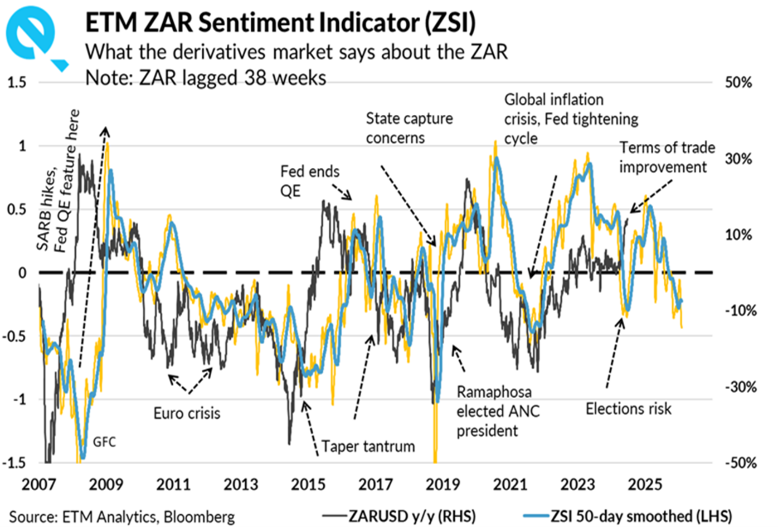
Oftentimes, investors look for fundamental justification for a market move to explain it. Most of the time, the diagnosis is wrong. Most forecasters, including the SARB, have a very poor track record in their currency forecasts. A currency market is driven by many factors, not all of them fundamental. Often, corporate deals can add a layer of flows through the market, sometimes giving the impression of a fundamental move playing out, when in fact the move has nothing to do with the fundamental justification. A case in point was Saudi Arabia’s Zahid Group’s $1.4bn acquisition of Barloworld. Given that it was listed on the JSE, the bulk of those flows were repatriated, which had a positive impact on the ZAR, as banks involved would’ve sold USDs for ZAR to complete the transaction. At the margin, that would’ve played a role in shifting the bias in the ZAR market. And as that bias has shifted, it is worth paying attention to the hedging behaviour of significant FX dealers in the ZAR market, including treasury professionals within corporates and fund managers that manage the country’s biggest FX exposures. The ZAR Sentiment Indicator (ZSI) seeks to quantify sentiment that reflects their trading behaviour, and judging from the chart above, that sentiment recently turned negative. One would expect the desire to hedge against ZAR weakness to tick up as the ZAR trades stronger. That forms a significant reason why the ZSI has dipped. The implication is that the ZAR will likely lose momentum in the coming months, potentially losing ground towards the middle of this year and into Q3. |
 |