
 Hedging
 Liquidity Solutions
 Cash Flow Forecasting
 Corporate Treasury Outsourcing
 Treasury Tecnology
 Connectivity
 Supply Chain Finance
 SME Forex
 Money Market Funds
Understanding Corporate Cash Management
What “Good” Cash Management Looks Like
Key Components of Effective Cash Management
Strategies to Optimise Cash Flow
The Role of Technology in Cash Management
Best Practices for Cash Forecasting
Risk Management and Controls in Cash Management
KPIs That Matter: Reporting the Right Measures to Leadership
How does TreasuryONE help businesses reduce the opportunity of idle cash?
Intro
Corporate cash management is the discipline of keeping the business liquid and in control, while reducing value lost to idle cash, fragmented balances, or unnecessary borrowing. It ensures the organisation has the right cash, in the right place, at the right time, with risk managed appropriately.
Done well, it’s more than day-to-day processing. It directly impacts profitability (interest earned or saved), resilience (ability to absorb shocks), and decision-making (funding growth, capex, dividends, and risk buffers with confidence). The goal is a repeatable operating rhythm: forecast accurately, concentrate cash, fund obligations efficiently, invest surplus within policy, and report performance in measures that translate into financial impact.
Understanding Corporate Cash Management
At its core, cash management is about timing and certainty:
- When cash comes in (sales collections, other receipts)
- When cash goes out (payroll, suppliers, tax, capex, debt service)
- Where cash sits (which bank, which account, which entity)
- What it costs or earns (interest paid on funding vs yield on investments)
The challenge is balancing two realities:
- You need enough cash available to run the business and handle surprises.
- Holding too much cash in low-yield accounts creates hidden costs and missed opportunities.

What “Good” Cash Management Looks Like
Strong cash management consistently delivers three outcomes:
1) Liquidity: The business meets obligations without stress, last-minute funding, or operational disruption.
2) Control: Visibility over cash positions, bank activity, and payment approvals is reliable, timely, and auditable.
3) Value: Surplus cash is deployed efficiently (within policy), and expensive funding is reduced where possible.
A simple hierarchy helps guide decisions:
- Protect the operating buffer (agreed minimum liquidity)
- Eliminate expensive debt first (overdrafts, revolvers, short-term borrowings)
- Concentrate and sweep surplus (avoid idle or trapped cash)
- Invest surplus within policy (liquidity and risk first, then yield)
- Support strategy (capex, growth, M&A, shareholder actions)
Key Components of Effective Cash Management
 Cash flow forecasting: A forward view of expected inflows and outflows (typically a rolling 13-week forecast plus longer-range visibility where needed). The point is not perfection; it’s early warning and better decisions.
Liquidity management: Ensuring the company has enough cash or readily available liquidity (cash, deposits, committed facilities) to meet near-term obligations and handle volatility, without holding excessive idle balances.
Funding and investment decisions: Optimising the balance between reducing borrowing costs, and earning a return on surplus funds,while maintaining policy limits on risk, liquidity, and counterparties.
Risk, governance, and controls: Clear rules on who can move money, where it can be invested, how bank access is controlled, and what happens in a disruption scenario.
A Practical Operating Model (So It Doesn’t Stay Theoretical): Cash management improves fast when it becomes a routine, not a once-off project.
Weekly cadence (Treasurer / Finance team)
- Update rolling cash forecast (13-week view)
- Review variances vs last week and identify drivers
- Confirm liquidity vs the agreed operating buffer
- Sweep or allocate surplus and reduce overdrafts
- Review exceptions: late collections, unusual payments, bank issues
Monthly cadence (CFO / Head of Finance view)
- Review cash performance scorecard (KPIs below)
- Validate buffer levels and funding strategy
- Review investment outcomes vs benchmark and policy
- Identify structural issues: trapped cash, recurring forecast bias, working capital leakage
Quarterly cadence
- Refresh policy parameters (buffers, limits, approved instruments and counterparties)
- Stress-test liquidity scenarios and update contingency plan
- Review bank structure (pooling, sweeping, account rationalisation, signatories and controls)
Strategies to Optimise Cash Flow
1) Strengthen collections (accounts receivable)
Improving inflows is often the quickest way to reduce pressure on liquidity.
- Tighten credit terms where appropriate and enforce them consistently
- Invoicing discipline: accurate invoices, sent immediately, with the right PO and supporting docs
- Clear escalation process for overdue accounts
- Consider early-payment incentives only when the economics make sense (and measure the true cost)
Practical tip: track the top 10 overdue accounts weekly with owners and actions, not just an ageing report.
2) Improve payment discipline (accounts payable)
Good cash management is not “pay late.” It’s “pay right.”
- Align payment runs with forecast inflows and required liquidity
- Use agreed terms consistently and avoid ad hoc early payments unless there is a priced benefit
- Negotiate terms where you have leverage, and document them properly
- Centralise and standardise supplier onboarding to avoid payment errors and fraud risk
Practical tip: build a rolling view of the next 30 days of payables and match it to expected receipts.
3) Optimise inventory (where relevant)
Inventory is cash in another form. Excess stock ties up funding and increases risk.
- Set target inventory levels based on demand patterns and service requirements
- Use faster-moving replenishment for key items where feasible
- Improve data quality (SKU accuracy, write-offs, slow-moving stock)
- Align procurement decisions with real sales forecasts
4) Concentrate cash and eliminate trapped balances
Many companies lose value because cash is spread across accounts and entities while another part of the business borrows.
- Implement sweeping or pooling where feasible
- Reduce the number of accounts and rationalise bank structures
- Set clear rules for operational balances vs investable cash
- Actively identify and release trapped cash (legal, tax, or operational constraints)
5) Reduce structural overdrafts and expensive funding
If you have surplus cash sitting idle while paying overdraft interest elsewhere, you’re paying for cash you already have.
- Net positions across accounts and entities where permitted
- Prioritise paying down high-cost debt before chasing marginal yield
- Align funding strategy to forecast reliability (don’t fund long when volatility is short)
6) Invest surplus cash within policy
Investment strategy should be built on three priorities:
- Liquidity (access when needed)
- Risk limits (counterparty, instrument, concentration, tenor)
- Return (optimised within the first two constraints)
Typical instruments for surplus cash depend on policy and market conditions, but the principle remains the same: don’t take risks the business hasn’t approved, and don’t lock up liquidity needed for operations.
The Role of Technology in Cash Management
Technology should improve visibility and decision speed, not just add dashboards.
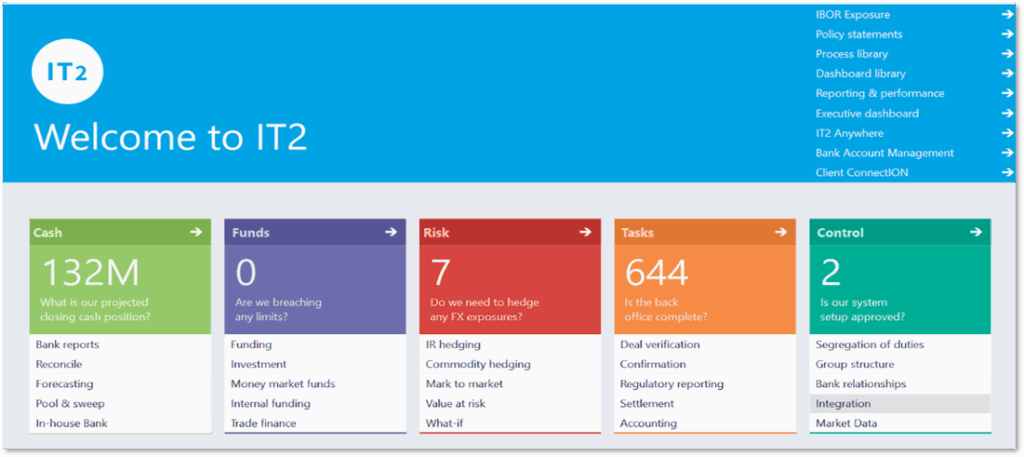
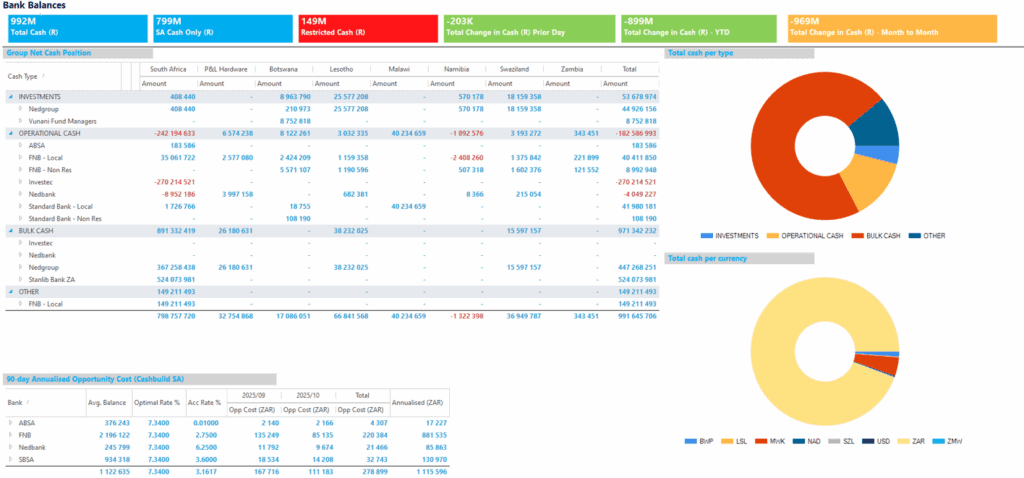
A Treasury Management System (TMS) is one of the most practical enablers of this. By connecting the TMS directly to your banking partners, you can automate bank statement and balance feeds across accounts and entities, giving treasury a near real-time view of cash positions in one place. This reduces manual bank portal logins and spreadsheet consolidation, improves daily cash concentration decisions (sweeps, funding, short-term investments), and strengthens control through standardised workflows, approvals, and audit trails. The result is faster daily cash management with fewer errors and clearer accountability.
High-impact uses include:
- Centralised cash positioning across banks and entities
- Automated bank statement feeds and reconciliation support
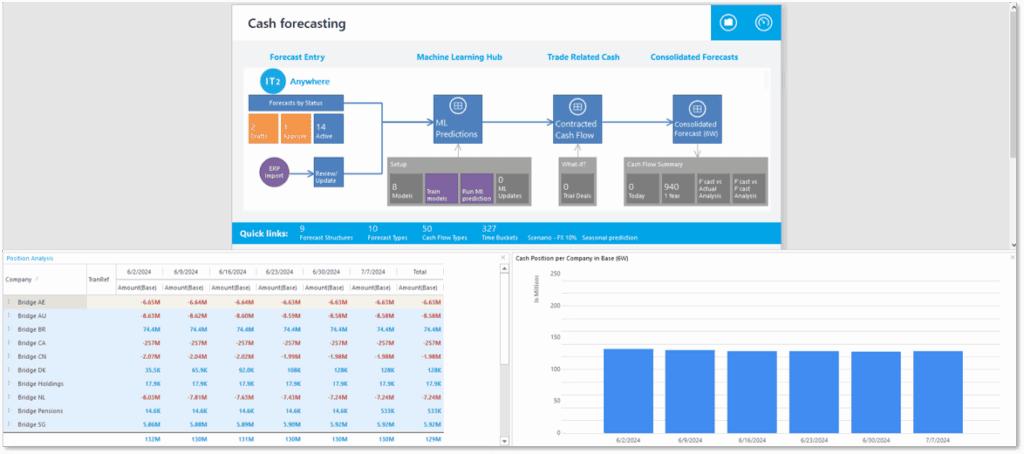
- Forecasting workflows that allow sales, procurement, and operations to contribute inputs from data derived from actual bank transactions.
- Payment controls: approvals, segregation of duties, audit trails
- Scenario planning: best case, base case, worst case liquidity views
Advanced analytics and AI help with trend forecasting, pattern detection, and more accurate forecasts that update daily as new bank statement information is imported from banks.
Best Practices for Cash Forecasting
A forecast is useful when it is:
- updated regularly,
- built from real operational drivers, and
- measured for accuracy and bias.
Key practices:
- Use a rolling 13-week forecast as a standard baseline with automated bank statement feeds and AI trend forecasting.
- Separate “known” items (payroll, tax, rent, debt service) from “estimated” items
- Track forecast performance by time bucket (near-term vs later weeks)
- Measure both accuracy and bias (consistent over-forecasting creates unnecessary buffers and hides opportunity cost)
- Get input from the people closest to the numbers: sales, operations, procurement, project teams
- Update the forecast frequently and explain the changes, not just the total
Risk Management and Controls in Cash Management
Cash is one of the highest-risk areas for fraud and operational errors. Strong controls protect the company and enhance confidence in governance.
Key risk practices:
- Clear investment policy (approved instruments, counterparties, tenors, limits)
- Diversification across approved institutions and instruments (within policy)
- Segregation of duties in payments (initiation, approval, release)
- Strong bank access controls (least privilege, regular access reviews, dual authorisation)
- Documented contingency plan for liquidity disruptions (market stress, operational outages, large, unexpected payments)
- Regular internal reviews or audits of cash processes and controls
KPIs That Matter: Reporting the Right Measures to Leadership
Cash KPIs should answer one question: Are we liquid, controlled, and creating value with our cash position? The most useful measures are those that translate activity into financial impact and drive the right behaviours.
1) Opportunity cost of cash (the main KPI for the CFO)
Definition: the value lost when cash sits idle in low-yield accounts or remains fragmented while the business funds itself at a higher cost elsewhere.
Why it matters: it converts treasury decisions into a single number in currency terms. It highlights the two most common sources of value leakage:
- idle cash not invested or swept, and
- expensive funding while cash is held elsewhere.
Simple calculation (practical):
Opportunity cost (period) = Σ[(benchmark rate − actual rate) × balance × days/365]
- Benchmark rate: an approved proxy (e.g., overnight investment rate or weighted short-term cost of debt)
- Apply only to cash above the agreed operating buffer
How to report it:
- ZAR opportunity cost for the month/quarter/YTD
- Split into idle cash vs funding mismatch
- Top drivers and actions taken (what changed and what you did)
2) Net interest impact (interest earned minus interest paid)
Shows the direct P&L effect of cash positioning, funding, and investment choices.
3) Liquidity coverage vs policy
Cash and committed facilities vs expected outflows, expressed as days/weeks of coverage and compliance with buffer requirements.
4) Forecast quality (accuracy and bias)
Accuracy by time bucket (next 2 weeks, weeks 3–6, weeks 7–13) plus bias tracking to prevent systematic over- or under-forecasting.
5) Cash concentration and trapped cash
Percentage of cash outside pooling or sweeping structures, by entity and bank.
6) Working capital indicators (supporting metrics)
DSO, DPO, and inventory days help explain drivers behind liquidity and forecasting movement, but they work best as supporting KPIs rather than the headline.
Common Mistakes to Avoid
- No reliable forecast: operating blind leads to expensive reactive decisions.
- Treating liquidity buffer as a guess: buffers should be policy-driven and reviewed, not “whatever feels safe.”
- Idle cash alongside overdrafts: this is one of the biggest and most avoidable costs.
- Too many bank accounts and fragmented cash: reduces visibility and control and increases opportunity cost.
- Chasing yield outside policy: liquidity and risk discipline matter more than marginal returns.
- Weak controls around payments: increases fraud risk and governance exposure.
Final Thoughts
Mastering corporate cash management comes down to discipline and consistency: maintain a reliable forecast, protect the operating buffer, concentrate cash, reduce expensive funding, invest surplus within policy, and report outcomes in measures leadership cares about.
If there’s one KPI to anchor executive reporting, it’s the opportunity cost of cash, because it translates cash management into a clear financial result. Over time, that focus strengthens liquidity, improves profitability, and gives the organisation greater confidence to invest and grow.
How does TreasuryONE help businesses reduce the opportunity of idle cash?
TreasuryONE helps businesses by turning cash visibility into disciplined daily cash management. Through our daily cash management service, we consolidate bank balances across accounts, entities, and banks into a single view, so surplus cash is identified early and acted on every day, not at month-end.
We enable this using world-class Treasury Management System (TMS) technology and our proven experience in bank connectivity and integration. By automating balance and statement feeds, we reduce manual bank portal work and spreadsheet consolidation, improve accuracy, and give treasury and finance teams timely, reliable cash visibility to make better daily decisions.
From there, our experienced cash management team executes the practical actions that reduce value leakage: maintaining agreed operational buffers, concentrating excess cash where possible, sweeping funds out of low-yield accounts, and aligning short-term investments and funding decisions so the business isn’t paying overdraft interest while cash sits idle elsewhere. We also strengthen forecasting routines and inputs to ensure decisions are based on a credible forward view.

Finally, we report the impact in CFO-friendly terms. We track opportunity cost in ZAR, explain the drivers (idle balances, trapped cash, funding mismatches), and show the measurable outcomes of actions taken. The result is a repeatable daily process that improves liquidity control, reduces interest leakage, and keeps cash working harder within the business’s risk and liquidity requirements.
For a free liquidity review, please click here