
 Hedging
 Liquidity Solutions
 Cash Flow Forecasting
 Corporate Treasury Outsourcing
 Treasury Technology
 Connectivity
 Supply Chain Finance
 SME Forex
 Money Market Funds
|
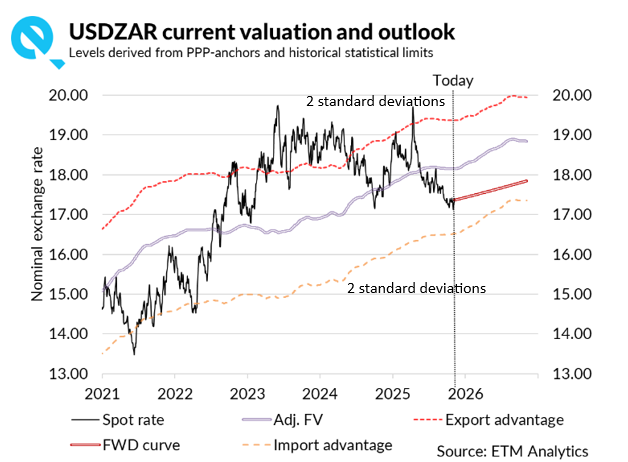
Currency: The rand has been holding relatively steady, ending October just 0.4% weaker against the US dollar. This mild weakness primarily stemmed from a stronger USD, supported by global risk aversion and shifting expectations regarding US interest rate cuts. Despite this, the rand performed better against the euro and pound and remains supported by solid commodity prices, South Africa’s removal from the FATF grey list, and improving fiscal discipline. Locally, inflation remains low and stable, providing the South African Reserve Bank (SARB) with room to start cutting interest rates—possibly from March 2026 onwards—which could boost growth but may add some pressure to the rand.
Looking ahead, the USD/ZAR is expected to trade mostly sideways or slightly higher in the near term as markets assess the upcoming fiscal outlook and global developments. However, if South Africa’s fiscal outlook improves and global risk appetite strengthens, the rand could regain ground toward R17.00. Overall, while short-term volatility remains, the medium-term outlook for the rand is supported by improving domestic fundamentals and a gradually softer US dollar backdrop. |
 |
|
Inflation: Headline inflation ticked up to +3.4% y/y in September from +3.3% y/y in August. Core CPI excluding volatile food and energy components ticked higher for the third consecutive month to +3.2% y/y from +3.1% y/y in August. Overall, low inflation outcomes are expected to persist into Q4, with consumer prices continuing to rise only modestly as we head towards 2026.
Repo rate: The muted inflation outlook implies that there is scope for further rate reductions by the SARB in coming months, even as it targets its preferred inflation target of 3%. ETM believes that a January rate cut remains possible, but that a March reduction is more likely, potentially followed by another one in September.
Government Finances: From a YTD perspective, the budget deficit stood at -R230.5bn, marking an improvement from the -R251.8bn recorded over the same period in the 2024/25 fiscal year. The delayed 2025/26 Budget has helped improve year-to-date budget balances through constrained expenditure ahead of the eventual passage of the 2025/26 Budget, while falling government bond yields have reduced debt-servicing costs, supporting the fiscal position.
GDP Growth: SA’s economy grew by +0.8% q/q in Q2, up from a marginal +0.1% q/q in Q1. On a y/y basis, slower growth of +0.6% was reported in Q2 from +0.8% in Q1. A temporary rebound in industrial production drove the uptick in quarterly GDP. Overall growth in 2025 is still likely to remain below +1.0% and the ongoing decline in investment further underscores the economy’s stagnation. Without stronger investment, prospects for sustained growth remain limited.
Currency: The ZAR closed October -0.4% weaker against the USD, ending the month mid-tier amongst emerging market currencies. This was a function of a stronger USD, which was supported by risk aversion amid mixed central bank signals, tech earnings, a tentative U.S.-China tariff truce at the time and traders reducing expectations for further Fed rate cuts in December. Nonetheless, the ZAR managed to perform relatively favourably against the EUR and GBP. It strengthened by 1.5% against the EUR in October and by 1.9% against the GBP.
Offshore conditions: Towards the end of the month, the US Fed cut interest rates by 25bps as expected. However, US Fed Chair Powell’s guidance was less dovish than expected, resulting in markets pricing out expectations for a December rate cut, which supported the USD against its major peers. In terms of US-Sino trade tensions, US President Donald Trump and China’s President Xi Jinping agreed to ease trade tensions through partial tariff reductions and new commitments on agricultural purchases. Beijing will suspend export controls on rare earths, while China is expected to purchase large volumes of US soybeans and other agricultural goods. |