 Hedging
 Liquidity Solutions
 Cash Flow Forecasting
 Corporate Treasury Outsourcing
 Treasury Technology
 Connectivity
 Supply Chain Finance
 SME Forex
 Money Market Funds
|
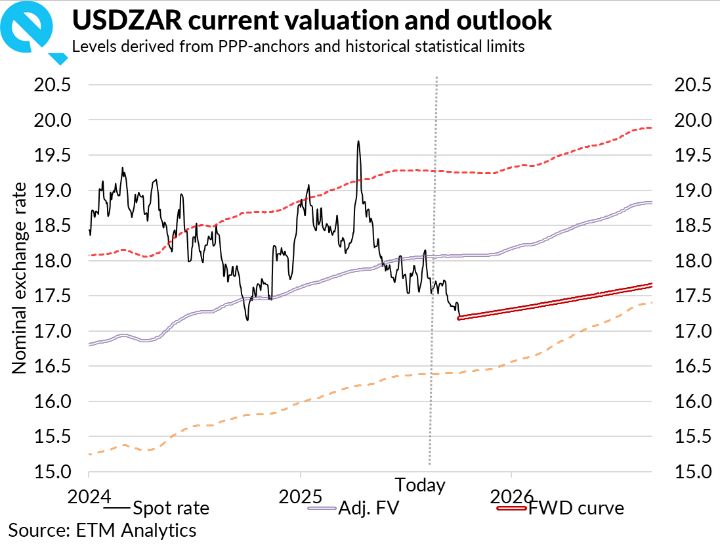
Currency: In September, the Rand had another strong month, gaining 2.3% against the US dollar and ranking as the third-best-performing emerging market currency. It also strengthened against the euro and the pound, supported by calmer global market conditions and steady investor appetite for risk. The Rand’s rise was boosted by foreign investment into South African bonds, bringing in fresh liquidity, lowering yields, and making South Africa even more appealing for carry trades. This steady inflow of capital has helped offset local fiscal challenges and reinforced confidence in the country’s improving political and economic outlook. With the US dollar still seen as overvalued and South Africa expected to be removed from the FATF “grey list,” the Rand remains well-positioned for further gains towards the R17.00 level, especially with strong gold prices and a supportive global backdrop. |
 |
|
Inflation: Headline CPI slowed unexpectedly to +3.3% y/y in August from +3.5% y/y in July. Core CPI (excluding food and energy) edged upwards to +3.1% y/y from +3.0% y/y in July. A lower CPI reading for August is surprising, but welcome, as ongoing low inflation will continue to support broader economic activity, mainly through resilient consumer spending. Repo rate: Despite the decline in CPI, the SARB opted to keep the interest rate unchanged as it steers market expectations towards its preferred 3% inflation target. This suggests rates are likely to stay higher for longer, with any potential cuts this year expected to be limited compared with previous low-inflation cycles. Government Finances: On a year-to-date perspective, the budget deficit stood at -R215.2 bn in August, improving from the -R251.6 bn deficit recorded over the same period in the 2024/25 fiscal year. The delay of the 2025/26 Budget legislation limited government expenditure until its eventual passage, temporarily supporting year-to-date budget readings compared to last year. However, this improvement is temporary unless concerted efforts are made to rein in spending and boost revenue. GDP Growth: SA’s economy grew by +0.8% q/q in Q2, up from a marginal +0.1% q/q in Q1. On a y/y basis, slower growth of +0.6% was reported in Q2 from +0.8% in Q1. A temporary rebound in industrial production drove the uptick in quarterly GDP. Overall growth in 2025 is still likely to remain below +1.0% and the ongoing decline in investment further underscores the economy’s stagnation. Without stronger investment, prospects for sustained growth remain limited. Offshore conditions: Speculators have recently been increasing bearish bets on the USD as global investors hedge currency risk while still pouring into US stocks and Treasuries. The move, driven by tariff concerns, Fed independence concerns and cheaper hedging costs from rate cuts, is keeping the dollar weak and could extend pressure into 2026 despite strong US asset inflows. Finally, weighing on the USD recently has been the US government shutdown, which suspends economic data releases and federal operations, whilst Trump escalates political confrontation through selective spending cuts. Investors continued to find refuge in safe-haven assets, most notably, gold, which reached new all-time highs. |