
 Hedging
 Liquidity Solutions
 Cash Flow Forecasting
 Corporate Treasury Outsourcing
 Treasury Technology
 Connectivity
 Supply Chain Finance
 SME Forex
 Money Market Funds
When there’s a war or a major energy shock, most people instinctively look at oil. It’s the number flashing across screens, the headline everyone talks about, and the easiest way to track what’s happening.
But if you want to understand whether that shock is going to spill into the real economy, whether it’s going to start affecting growth, inflation, and ultimately markets, there’s a more telling place to look.
Diesel
It’s not as visible, and it doesn’t get nearly the same attention. But it sits much closer to the actual engine of the economy. In South Africa, that link is even more direct. The economy is heavily reliant on road freight, energy-intensive mining, and diesel-powered backup generation during load-shedding.
And the scale is significant. South Africa consumes roughly 270,000 barrels of diesel per day (2023 data), equivalent to over 12 billion litres annually, a level that has remained structurally high for more than a decade. Even back in 2013, diesel consumption was already above 12 billion litres per year, and it has continued to trend higher as logistics and energy constraints have deepened.
Diesel is what powers the physical world. It runs the trucks that move goods between cities, the ships that carry containers across oceans, the machinery used in mining and construction, and the equipment that produces and transports food. In South Africa, where rail inefficiencies have shifted even more freight onto roads, diesel effectively underpins the entire logistics system.
And it goes beyond transport. During periods of load-shedding, diesel becomes a substitute for electricity. At the peak of the power crisis in 2022, Eskom alone was burning up to 9 million litres of diesel per day, highlighting how diesel demand in South Africa extends beyond traditional economic activity into energy security.
So, when diesel prices rise, it doesn’t stay contained within the energy market; it flows directly into the cost of doing business. That’s what makes it so important.
One of the simplest ways to track this is by looking at how diesel prices move relative to crude oil. When diesel starts rising faster than oil, it usually means something is tightening beneath the surface. Refineries are struggling to keep up, supply chains are under pressure, and demand from the real economy is still holding firm.
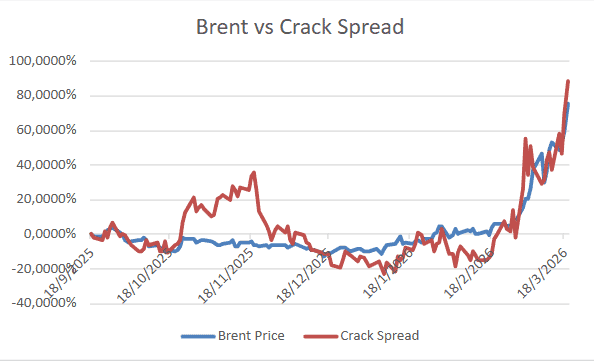
From the graph above, we can see the direct impact on the crack spread (Red) following the US offensive against Iran. Although Brent Crude (Blue) has followed suit in trading higher, it is starting to be outpaced by the crack spread.
This gap, often referred to as the diesel crack spread, isn’t widely followed outside of commodity circles. But it quietly tells you when the system is starting to strain.And the impact is immediate.
Unlike crude oil, which can take time to filter through the economy, diesel hits quickly. Transport companies face higher fuel bills almost overnight. Producers see input costs rise. Farmers pay more to plant and harvest. In a country where total fuel consumption is around 60 million litres per day (2023 estimates), these changes scale rapidly through the economy.
Gradually, those costs get passed along, into goods, into food, and into everyday prices. At first, businesses try to absorb the pressure. Margins compress slightly. Then they begin to pass costs on. And if the pressure persists, activity starts to slow.
This is where the pattern becomes interesting. If you look back at previous cycles, diesel tends to tighten just before broader economic stress becomes visible. Ahead of the 2008 financial crisis, transport costs surged as diesel margins climbed. During the commodity spike in the early 2010s, similar pressures contributed to slower global growth. More recently, in 2022, Europe experienced a sharp diesel shock after losing access to key refined fuel exports, further straining an already fragile economic environment.
In each case, diesel didn’t cause the slowdown, but it revealed the pressure building underneath.
Geopolitical conflicts tend to accelerate this dynamic. When war breaks out, countries often prioritise domestic fuel supply, limiting exports of refined products. Shipping routes become more complex and expensive, and military demand for fuel increases.
For South Africa, this risk is amplified by structure. The country is a net importer of refined fuels, with local refining capacity having declined in recent years. This means local diesel prices are influenced not just by global oil prices, but by global refining constraints and supply disruptions.
Crude can usually be rerouted. Because it depends on specific refining capacity, diesel is harder to replace quickly.
That’s why diesel markets often react first and more sharply.
What this ultimately tells you is simple. When diesel prices spike, the cost of moving, producing, and operating rises across the board. It’s not isolated. It spreads. And in South Africa, that spread is faster, broader, and more visible, cutting through transport, mining, agriculture, and even electricity supply. And when that happens, the economy doesn’t stop suddenly; it begins to slow down. So, while oil might tell you that something is happening, diesel tells you that it’s starting to matter. And that’s usually the point when markets should start paying closer attention.