
 Hedging
 Liquidity Solutions
 Cash Flow Forecasting
 Corporate Treasury Outsourcing
 Treasury Technology
 Connectivity
 Supply Chain Finance
 SME Forex
 Money Market Funds
|
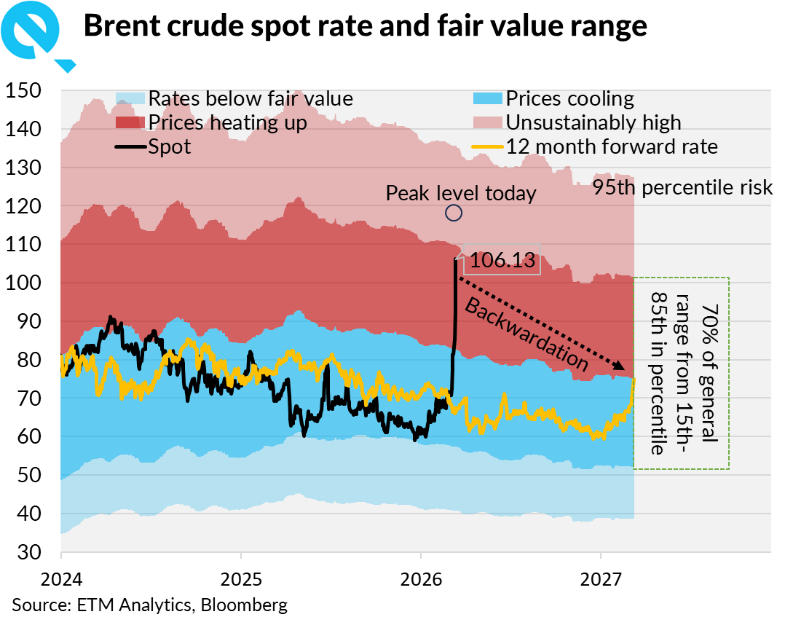
Oil prices surged toward $120/bbl in early March as escalating Middle East tensions and the closure of the Strait of Hormuz triggered a large geopolitical risk premium.
Around one-fifth of global oil consumption passes through the strait, meaning a major disruption could remove 10–14 million barrels per day from markets and create significant inflation and supply-chain shocks. However, such elevated price levels are historically difficult to sustain as alternative supply and market adjustments emerge.
Quantitative estimations of potential price Historical trading data and estimates of recovered fair value – defined as the level at which producers could have hedged forward production – suggest that prices could rise further in a severe disruption scenario. Based on past episodes of geopolitical stress, the upper end of plausible price outcomes could approach $140 per barrel. However, the broader bias remains toward lower prices over the medium term. The current futures curve provides an important signal: while spot prices remain elevated, the 12-month Brent contract is trading below $80, indicating deep backwardation. This suggests that while markets are pricing substantial near-term disruption risk, traders do not expect these conditions to persist indefinitely. |
 |