
 Hedging
 Liquidity Solutions
 Cash Flow Forecasting
 Corporate Treasury Outsourcing
 Treasury Technology
 Connectivity
 Supply Chain Finance
 SME Forex
 Money Market Funds
SUMMARY
The SARB’s decision to leave the repo rate unchanged at 7.00% was surprising to say the least. The Bank continues to expect inflation to moderate over the medium term, but risks are viewed as skewed materially to the upside. The decision is viewed as a hawkish hold rather than a dovish pause. Further rate hikes remain likely if inflation risks intensify.
Initial market reaction suggests that this may be viewed as a policy error with the ZAR weakening sharply. Time will tell. Positive developments in the US-Iran war would vindicate the hold, but prolonged conflict, further ZAR weakness, and persistently elevated global crude prices would require a policy response that may then need to be more severe than if the SARB had acted now.
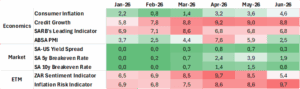
The Monetary Policy Committee’s decision to leave the repo rate unchanged at 7.00% reflects an unexpected confidence that the current policy stance is already sufficiently restrictive. The global macroeconomic environment remains characterised by elevated uncertainty and persistent inflation risks. Inflation has accelerated in recent months and the risk is that disinflation from here on is gradual at best. Renewed geopolitical tensions, higher energy prices and increasingly fragmented global trade will likely continue to complicate the global disinflation process. Central banks have consequently become more cautious, with most maintaining restrictive policy settings as they seek greater confidence that inflation will return sustainably to target.
Although domestic demand remains relatively subdued, the economy has been exposed to imported inflation through higher oil prices and fuel costs, while inflation expectations have become less favourable. Headline CPI has accelerated over recent months and, importantly, core inflation has also begun to firm, suggesting that some second-round effects are emerging. At the same time, growth remains modest, reflecting weak private investment, structural supply constraints and subdued consumer spending. This leaves policymakers balancing a deteriorating inflation outlook against an economy that continues to operate below its potential.
ETM Analytics’ dashboard reflects this changing macro environment. Consumer inflation has steadily moved into more restrictive territory during 2026, while market-based inflation expectations, as measured by the 5-year and 10-year breakeven inflation rates, have increased materially since March. The Inflation Risk Indicator has risen to its highest level of the year, signalling that upside inflation risks remain elevated despite some recent moderation in energy prices. Meanwhile, credit growth remains resilient, suggesting monetary conditions have not become sufficiently restrictive to materially constrain lending, while the SARB Leading Indicator points to slower, but still positive, economic activity. Manufacturing conditions remain uneven, with the ABSA PMI highlighting the continued headwinds facing the production sector.
Read report