 Hedging
 Liquidity Solutions
 Cash Flow Forecasting
 Corporate Treasury Outsourcing
 Treasury Technology
 Connectivity
 Supply Chain Finance
 SME Forex
 Money Market Funds
The SARB delivered a unanimous hold at 6.75%, but the March MPC statement carried a distinctly more hawkish tone as the Middle East oil shock shifted risks toward higher inflation and delayed the easing cycle. While the SARB’s baseline still sees inflation returning to 3%, the QPM now pushes rate cuts into the second half of 2026 and explicitly incorporates scenarios that would require renewed tightening if energy prices remain elevated or the rand weakens materially.
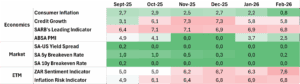
Looking at our dashboard above, we see that it has once again turned less supportive of monetary policy easing, primarily due to risks of a weaker ZAR and higher inflation. Even before the war had begun, ETM’s ZAR Sentiment Indicator had started deteriorating. The message at the time was clear. The ZAR had appreciated aggressively, and at some point, that trading action would become too one-sided to remain sustainable. It appears this point was reached before the war began, leaving the ZAR vulnerable to a selloff. We maintain that the ZAR’s fundamentals remain strong, but the risk of near-term volatility remains elevated, which will keep the SARB cautious going forward.
Interestingly, the SARB complemented its baseline forecast with two adverse scenarios centred on the potential persistence of the Middle East conflict and higher oil prices. In the first scenario, where the war lasts a few months, oil near US$100, and the rand about 5% weaker, inflation rises above 4%, and the SARB would likely need one additional rate hike this year before inflation gradually returns to target around 2027.
In the more severe scenario, with the conflict lasting over a year, oil remaining above US$100 and the rand weakening roughly 10%, inflation would exceed 5% and require several rate hikes, with the policy rate potentially approaching levels seen in the previous tightening cycle. In both cases, growth weakens initially due to higher costs and uncertainty, but the key message is that the SARB stands ready to tighten policy if second-round inflation pressures emerge.
Read report