
 Hedging
 Liquidity Solutions
 Cash Flow Forecasting
 Corporate Treasury Outsourcing
 Treasury Technology
 Connectivity
 Supply Chain Finance
 SME Forex
 Money Market Funds
Any attempt to explain why US Treasury yields have remained higher than past cycles has to begin with inflation expectations, and the market’s own pricing leaves little doubt that something has changed. Comparing breakeven inflation rates through the decade to 2020 with the period since, the accompanying charts show an upward shift at both the five- and 10-year rates. The University of Michigan’s survey of household expectations tells the same story.
This follows an extended period of inflation above the Federal Reserve’s 2% target. Supply shocks once treated as isolated have become recurring, first with Russia’s invasion of Ukraine and now with the conflict between the United States and Iran. With no end in sight to these wars, investors must price more frequent energy shocks. Tariffs, reshoring, and broader supply-chain fragmentation have removed a disinflationary impulse that flattered inflation data for most of 30 years. All the while, fiscal deficits are running at levels once reserved for recessions despite strong growth, and the artificial intelligence buildout is itself inflationary in the near term by raising competition for electricity, construction capacity, skilled labour, and semiconductors.
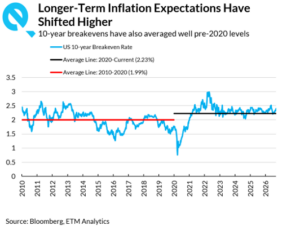
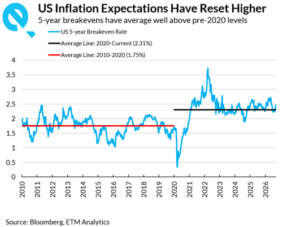
Measured against the full move in vanilla yields over the same period, only part can be explained by higher inflation expectations. Inflation still matters, but through a different channel. Both 5-year and 10-year breakevens have reset above their pre-2020 averages, suggesting markets now assume a structurally higher inflation backdrop than prevailed in the 2010s. Even so, expectations remain relatively well anchored, with 5-year compensation only modestly above the 10-year, implying the current energy shock is expected to fade rather than become permanently embedded. This points to a market pricing in somewhat higher inflation, with a temporary war premium layered on top. However, the Fed’s 2% target itself still appears credible. A more important route, in our view, runs through inflation uncertainty. Inflation can drive high yields even if expected inflation moves little, if inflation uncertainty is what changed. Higher uncertainty about the inflation path raises the term premium demanded on bonds. The clearest observable evidence for this comes from the relationship between bonds and equities.
For most of the period between the late 1990s and 2020, the dominant risk facing markets was an economic demand shortfall. When growth disappointed, equities fell, inflation fell with them, central banks cut rates, and bonds rallied. Bonds therefore hedged equities, and investors accepted a lower yield in exchange for portfolio stability. In an inflation-driven world, the mechanism reverses: a supply shock raises prices and damages growth at the same time, so bonds and equities fall together, which can hurt a portfolio significantly. As the adjacent chart shows, that is largely what has happened since 2021, and a bond that no longer protects a portfolio has to compensate its holder with yield instead.
Read the full report here