
 Hedging
 Liquidity Solutions
 Cash Flow Forecasting
 Corporate Treasury Outsourcing
 Treasury Tecnology
 Connectivity
 Supply Chain Finance
 SME Forex
 Money Market Funds
Daily Market Report – 21 July 2026
Middle East Conflict Escalates Further
Geopolitical risk intensified overnight after Yemen’s Houthis announced a maritime blockade of Saudi Arabia, threatening Red Sea shipping routes that Riyadh has increasingly relied upon following disruptions in the Strait of Hormuz.
The development places approximately 4% of global oil supply at risk and significantly complicates diplomatic efforts to reduce tensions between Iran and the United States. ETM notes that a full closure of Red Sea shipping routes could push Brent crude above $100 per barrel, making a negotiated resolution increasingly difficult.
Meanwhile, the conflict between the US and Iran entered a tenth consecutive day of military operations, with continued strikes against Iranian military infrastructure while diplomatic efforts continue through regional mediators including Qatar and Pakistan.
Trade Tensions Return to Centre Stage
Markets are also digesting renewed trade risks after US President Donald Trump imposed 50% tariffs on US$20 billion of Canadian imports, invoking Section 338 of the 1930 Tariff Act for the first time.
The move reopens trade tensions across North America and introduces a faster legal mechanism for imposing tariffs, although negotiations before 19 August could still soften or delay implementation.
Investors will also monitor fresh US-Mexico trade negotiations, covering steel, automobiles, agriculture and labour, for signs that North American trade relations can stabilise without further tariff escalation.
SARB in Focus as Inflation Risks Increase
The South African Reserve Bank dominates the domestic agenda this week.
ETM argues that South Africa has limited control over external shocks such as geopolitical tensions and oil prices, leaving monetary policy as its most effective tool. Rising oil prices have increased the probability that the SARB will implement another 25 basis point rate hike to prevent second-round inflation effects from becoming entrenched.
This stresses that the cost of inaction may now exceed the cost of tightening policy, particularly if a weaker rand amplifies imported inflation. Markets appear increasingly comfortable pricing in another rate increase.
Bond Markets Reflect More Than Just Rate Expectations
South African bond yields continued to climb sharply, although ETM cautions that the move reflects more than expectations surrounding this week’s MPC meeting.
The sell-off has been concentrated in the belly and longer end of the yield curve, highlighting investor concerns over inflation, fiscal sustainability and weaker economic growth rather than simply expectations for higher policy rates. Bond yields have risen by more than 25 basis points over the past week.
Forward Rate Agreements (FRAs) also moved higher, reinforcing market expectations for additional monetary tightening. Longer-dated contracts continue to price elevated interest rates, with oil prices remaining the primary driver of inflation expectations.
Goldman Sachs Warns Oil Could Reach $120
Energy markets remain exceptionally sensitive to developments in the Middle East.
Goldman Sachs warned that Brent crude could exceed $120 per barrel during the fourth quarter if shipping disruptions through the Strait of Hormuz persist. Its central forecast still assumes oil moderates towards $80 in Q4 and $75 by 2027, but risks remain firmly skewed to the upside.
The bank highlighted diesel markets as particularly vulnerable and recommended positioning for tighter European diesel supplies should geopolitical disruptions continue.
Agricultural commodities also strengthened as stronger Chinese demand, adverse US weather and renewed Black Sea shipping disruptions lifted soybean and corn prices.
Gold Holds Firm Despite Higher Rate Expectations
Gold continued to attract safe-haven demand, finding support near $4,000 per ounce.
However, ETM notes that any sustained rally remains constrained by expectations that higher energy prices will keep inflation elevated and encourage the Federal Reserve to maintain tighter monetary policy. This creates opposing forces between geopolitical demand for gold and higher real interest rates.
Meanwhile, the US announced incentives aimed at reducing aluminium tariffs for companies investing in domestic production, seeking to ease supply shortages while maintaining industrial investment incentives.
South Africa’s Water Infrastructure Reform
Away from financial markets, President Cyril Ramaphosa announced the establishment of a new state-owned company responsible for major water infrastructure.
ETM argues that while consolidating bulk water management could improve project financing and infrastructure delivery, the reform does not address municipal distribution failures, which remain the principal source of South Africa’s water challenges. Businesses are therefore advised to continue investing in local water resilience rather than assuming national reforms will solve operational supply issues.
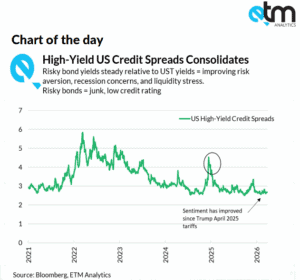
Chart of the Day — Credit Markets Signal Improving Risk Appetite
The chart highlights that US high-yield credit spreads continue to consolidate, suggesting recession fears and liquidity concerns have eased compared with the period immediately following the 2025 tariff announcements. While geopolitical risks remain elevated, credit markets are not yet signalling widespread financial stress.
Bottom Line
Markets remain dominated by geopolitical risk, with developments in the Middle East continuing to drive oil prices, inflation expectations and global risk sentiment. For South Africa, attention is firmly focused on Thursday’s SARB meeting, where a 25bp rate hike is increasingly viewed as the most likely outcome to protect the rand and anchor inflation expectations. Until geopolitical tensions ease, the rand, bond yields and commodity markets are likely to remain highly sensitive to every new development.
Daily Market Report – 21 July 2026
Weekly Market Video

Middle East Talks Ease Markets, but Inflation and Rate Hike Risks Remain in Focus
Global markets entered the week with some relief as signs emerged that tensions in the[...]
View ReportAug
Economic Insights

Some relief for the ZAR, but risks remain
Key points This week’s local GDP and current account data surprised to the upside, led[...]
View ReportJun
FX Update

Apr 2026
Currency: The rand had a strong run for most of the past year, climbing steadily against[...]
View ReportMay
Interest Rates

Monthly Rates Dashboard – Apr 2026
Inflation: Headline consumer inflation slowed by more than expected from 3.5% y/y in January to[...]
View ReportMay
SARB insight

SARB decision may come back to haunt it
Last week’s SARB decision did not go down well. The ZAR has capitulated. One could[...]
Veiw ReportJul
Commodities
A New Way to Get Paid: What Standard Bank’s RMB Clearing Role Means for SA Exporters
China’s central bank has picked Standard Bank and ICBC to handle Chinese currency (RMB) payments[...]
View ReportJun
Why choose TreasuryONE
-
Deep Expertise: Our team offers over 150 years of combined financial experience.
-
Cost-Efficient: Outsourced risk management cuts costs by sharing our expertise, systems, and scale.
-
Fair FX Pricing: We understand how banks price and use that knowledge to secure fair, competitive rates.
-
Technology-Led: Real-time insights and robust reporting via advanced treasury systems and analytics.
-
Proactive Support: We offer consistent updates, strategic advice, and timely hedging recommendations.