
 Hedging
 Liquidity Solutions
 Cash Flow Forecasting
 Corporate Treasury Outsourcing
 Treasury Tecnology
 Connectivity
 Supply Chain Finance
 SME Forex
 Money Market Funds
Daily Market Report – 5 Aug 2026
Diplomatic Progress Boosts Market Confidence
Markets responded positively after President Donald Trump indicated that negotiations with Iran were progressing, while Qatar confirmed that mediators had drafted a de-escalation proposal aimed at reopening the Strait of Hormuz. Reopening the strategic shipping route would restore roughly one-fifth of global oil shipments, easing pressure on global energy prices and inflation.
Although Brent crude fell below $79 per barrel as traders priced in a more durable resolution, investors remain cautious. Previous ceasefire agreements have collapsed over similar disputes, leaving uncertainty around the longer-term outlook for regional stability and energy markets.
Oil Retreat Brings Relief for South Africa
Momentum behind diplomatic efforts has already filtered through to global oil markets, with Brent crude falling below $80 per barrel for the first time in nearly a month. A sustained decline in oil prices would provide welcome relief for South Africa by lowering fuel costs, easing inflationary pressures and improving the country’s terms of trade. It would also support the rand and reduce pressure on household and business finances.
While the outlook has improved, markets remain aware that any interim agreement would not necessarily resolve the broader geopolitical issues, leaving the possibility of renewed volatility should negotiations falter.
US Labour Market Shows Signs of Cooling
US job openings declined to 7.36 million in June, coming in below expectations and suggesting labour demand continues to moderate gradually rather than deteriorate sharply. Stable quits and layoff rates indicate employers remain reluctant to reduce headcount, helping to limit upward pressure on unemployment.
Markets are now focused on today’s US ISM Services Index and Friday’s non-farm payrolls report, both of which are expected to play a key role in shaping expectations for future Federal Reserve policy.
Rand Strengthens as Oil Prices Fall
The sharp decline in oil prices has translated directly into renewed strength for the rand, with USD/ZAR moving back below 16.35. Lower oil prices improve South Africa’s inflation outlook while strengthening expectations for improved trade dynamics and broader economic performance.
Despite the stronger currency, caution remains warranted. Recent geopolitical agreements have proved fragile, and any reversal in diplomatic progress could quickly see the rand surrender its gains. Current market conditions nevertheless continue to favour importers looking to secure forward cover at attractive exchange rates.
Local Bond Market Benefits from Improved Inflation Outlook
Yesterday’s National Treasury bond auction attracted slightly weaker demand for a fourth consecutive week, although the broader backdrop for South African bonds has become more supportive. Falling oil prices and a firmer rand have improved the domestic inflation outlook, contributing to lower government bond yields across the curve.
Investor demand remains selective, particularly for longer-dated bonds, as elevated US Treasury yields continue to compete for global capital. FRA pricing has also moderated, with markets now implying only one further 25 basis point rate hike over the coming months, reflecting expectations that easing inflation could reduce the need for further monetary tightening.
Commodity Markets
Oil prices extended losses for a third consecutive session as optimism surrounding a temporary Hormuz agreement continued to build. In addition to improving diplomatic prospects, a larger-than-expected increase in US crude inventories reinforced expectations of ample near-term supply.
Gold advanced towards $4,095 per ounce, supported by expectations that softer inflation and reduced geopolitical risks may allow the Federal Reserve to adopt a less aggressive policy stance. Copper prices also strengthened, driven by tightening global supplies and robust US import demand.
Chart of the Day
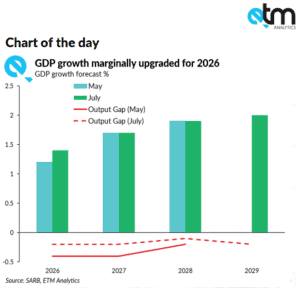
Today’s chart highlights revised South African GDP growth forecasts, showing a modest upward revision for 2026 while illustrating the expected evolution of the output gap over the medium term.
Bottom Line
Improving prospects for a temporary agreement to reopen the Strait of Hormuz have significantly lifted market sentiment, sending oil prices lower, strengthening the rand and improving South Africa’s inflation outlook. While the recent optimism has supported both local bonds and the currency, markets remain alert to the possibility that negotiations could yet unravel. Attention now turns to today’s US economic data for further guidance on the outlook for global growth and Federal Reserve policy.
Daily Market Report – 5 Aug 2026
Weekly Market Video

Middle East Talks Ease Markets, but Inflation and Rate Hike Risks Remain in Focus
Global markets entered the week with some relief as signs emerged that tensions in the[...]
View ReportAug
Economic Insights

Some relief for the ZAR, but risks remain
Key points This week’s local GDP and current account data surprised to the upside, led[...]
View ReportJun
FX Update

Apr 2026
Currency: The rand had a strong run for most of the past year, climbing steadily against[...]
View ReportMay
Interest Rates

Monthly Rates Dashboard – Apr 2026
Inflation: Headline consumer inflation slowed by more than expected from 3.5% y/y in January to[...]
View ReportMay
SARB insight

SARB decision may come back to haunt it
Last week’s SARB decision did not go down well. The ZAR has capitulated. One could[...]
Veiw ReportJul
Commodities
A New Way to Get Paid: What Standard Bank’s RMB Clearing Role Means for SA Exporters
China’s central bank has picked Standard Bank and ICBC to handle Chinese currency (RMB) payments[...]
View ReportJun
Why choose TreasuryONE
-
Deep Expertise: Our team offers over 150 years of combined financial experience.
-
Cost-Efficient: Outsourced risk management cuts costs by sharing our expertise, systems, and scale.
-
Fair FX Pricing: We understand how banks price and use that knowledge to secure fair, competitive rates.
-
Technology-Led: Real-time insights and robust reporting via advanced treasury systems and analytics.
-
Proactive Support: We offer consistent updates, strategic advice, and timely hedging recommendations.